| San Diego Education Report |
Los Angeles ACLU wins case against layoffs based on seniority at
low-income schools--but San Diego ACLU refuses to take action
Possible Layoffs Would Hit Schools With Poor Students Hardest
by Emily Alpert
Voice of San Diego
Seventeen schools in San Diego Unified would lose more than one-fourth of their
teaching staff if the school board votes for layoffs this week, according to a memo from its
deputy superintendent. The hardest hit school would be Baker Elementary, which would
lose 44 percent of its educators.
Under state law, the newest teachers are generally the first to lose their jobs. It's
commonly known as "last hired, first fired." That means schools with lots of new teachers
get hit harder when layoffs strike, as we recently explained with NBC San Diego. Most of
the hardest hit schools have high percentages of disadvantaged kids.
To put these numbers in perspective, the average San Diego Unified elementary school
has 64 percent of students eligible for free or reduced price lunches; middle schools
average 60 percent eligible.
The new numbers back up an old worry: That layoffs have a disproportionate impact on
the neediest schools. The biggest school district in the state, Los Angeles Unified,
recently struck a legal settlement with the Public Counsel Law Center and
the American Civil Liberties Union of Southern California to protect
disadvantaged schools from teacher layoffs.
low-income schools--but San Diego ACLU refuses to take action
Possible Layoffs Would Hit Schools With Poor Students Hardest
by Emily Alpert
Voice of San Diego
Seventeen schools in San Diego Unified would lose more than one-fourth of their
teaching staff if the school board votes for layoffs this week, according to a memo from its
deputy superintendent. The hardest hit school would be Baker Elementary, which would
lose 44 percent of its educators.
Under state law, the newest teachers are generally the first to lose their jobs. It's
commonly known as "last hired, first fired." That means schools with lots of new teachers
get hit harder when layoffs strike, as we recently explained with NBC San Diego. Most of
the hardest hit schools have high percentages of disadvantaged kids.
To put these numbers in perspective, the average San Diego Unified elementary school
has 64 percent of students eligible for free or reduced price lunches; middle schools
average 60 percent eligible.
The new numbers back up an old worry: That layoffs have a disproportionate impact on
the neediest schools. The biggest school district in the state, Los Angeles Unified,
recently struck a legal settlement with the Public Counsel Law Center and
the American Civil Liberties Union of Southern California to protect
disadvantaged schools from teacher layoffs.
Why This Website
Stutz Artiano Shinoff
& Holtz v. Maura
Larkins defamation
SDCOE
CVESD
Castle Park
Elementary School
Law Enforcement
CTA
CVE
Stutz Artiano Shinoff
& Holtz
Silence is Golden
Schools and Violence
Office Admin Hearings
Larkins OAH Hearing
Stutz Artiano Shinoff
& Holtz v. Maura
Larkins defamation
SDCOE
CVESD
Castle Park
Elementary School
Law Enforcement
CTA
CVE
Stutz Artiano Shinoff
& Holtz
Silence is Golden
Schools and Violence
Office Admin Hearings
Larkins OAH Hearing
Silence at Boalt Hall
The Dismantling of Affirmative Action
Andrea Guerrero
The Dismantling of Affirmative Action
Andrea Guerrero

Disadvantaged schools may get break in layoffs
Teachers at underperforming schools may get increased protection
By Maureen Magee
SAN DIEGO UNION-TRIBUNE
April 20, 2011
Cindy Marten, principal at Central Elementary School, greets student Kayla
Moyer, 8, on Wednesday. Teachers at disadvantaged schools like this got
a disproportionate number of pink slips warning of layoffs.
When one in six teachers in the San Diego school district were warned they
could lose their job last month, a disproportionate number of those pink
slips were issued at campuses serving the most disadvantaged students.
But as some layoff notices get rescinded — more than 40 percent have
been recalled so far — some teachers at the neediest schools have won
job protection over their colleagues in more affluent neighborhoods.
Critics have long complained that the “last hired, first fired” seniority-based
layoffs disrupt the stability of struggling schools that typically employ the
most new teachers. In a settlement to a lawsuit filed by the ACLU and the
Public Counsel Law Center, the Los Angeles school district exempted 45
needy campuses from seniority-based layoffs.
Since then, the San Diego Unified School District has started to chip away
at the practice that can lead to wholesale faculty changes at some of its
struggling campuses. Although the change is slight, it could begin to help
schools maintain some stability for disadvantaged students.“The overall
issue of trying to provide stability to high-poverty schools is something that
I believe in and the majority of the board believes in,” said San Diego
school board President Richard Barrera. “The question becomes, what is
the best way to get at that. For me the best way is not laying off teachers.”
When districts warn teachers they could be laid off, they issue pinks slips
by credential and hire date. Usually, more employees are tapped for layoffs
than necessary.
But undoing some or all of the layoff notices is more difficult and it requires
districts to turn to tiebreakers, criteria that determines whose pink slip to
rescind or which teacher to rehire when educators share similar credentials
and seniority dates.
Tiebreakers usually include additional credentials or specialty
certifications. But this year, San Diego Unified’s No. 1 tiebreaker is whether
a teacher works at a school ranked in the bottom three deciles on the
Academic Performance Index, an indication they are struggling to meet test
score goals.
“When these schools can have the same teachers year after year, that
helps with stability,” said Hedieh Khajari, human resources officer for San
Diego Unified.
The district issued layoff notices to 1,355 educators in March to help offset
a projected deficit of $114 million to the district’s $1.04 billion operating
budget. Teachers targeted for pink slips hold various credentials and were
hired since 2003, the year of a hiring spree due, in part, to a state program
to trim class sizes.
Since its budget plan has changed slightly in the past few weeks, the
district has rescinded at least 559 pink slips issued to elementary school
teachers, music teachers, and school nurses. The layoff notices were
canceled based on seniority first, then based on a list of 25 tiebreakers if
necessary.
At Central Elementary School in City Heights, where most students qualify
for subsidized meals and speak English as a second language, 41 percent
of teachers got pink slips. So far, four of those 16 teachers had their
notices rescinded.
Teachers at underperforming schools may get increased protection
By Maureen Magee
SAN DIEGO UNION-TRIBUNE
April 20, 2011
Cindy Marten, principal at Central Elementary School, greets student Kayla
Moyer, 8, on Wednesday. Teachers at disadvantaged schools like this got
a disproportionate number of pink slips warning of layoffs.
When one in six teachers in the San Diego school district were warned they
could lose their job last month, a disproportionate number of those pink
slips were issued at campuses serving the most disadvantaged students.
But as some layoff notices get rescinded — more than 40 percent have
been recalled so far — some teachers at the neediest schools have won
job protection over their colleagues in more affluent neighborhoods.
Critics have long complained that the “last hired, first fired” seniority-based
layoffs disrupt the stability of struggling schools that typically employ the
most new teachers. In a settlement to a lawsuit filed by the ACLU and the
Public Counsel Law Center, the Los Angeles school district exempted 45
needy campuses from seniority-based layoffs.
Since then, the San Diego Unified School District has started to chip away
at the practice that can lead to wholesale faculty changes at some of its
struggling campuses. Although the change is slight, it could begin to help
schools maintain some stability for disadvantaged students.“The overall
issue of trying to provide stability to high-poverty schools is something that
I believe in and the majority of the board believes in,” said San Diego
school board President Richard Barrera. “The question becomes, what is
the best way to get at that. For me the best way is not laying off teachers.”
When districts warn teachers they could be laid off, they issue pinks slips
by credential and hire date. Usually, more employees are tapped for layoffs
than necessary.
But undoing some or all of the layoff notices is more difficult and it requires
districts to turn to tiebreakers, criteria that determines whose pink slip to
rescind or which teacher to rehire when educators share similar credentials
and seniority dates.
Tiebreakers usually include additional credentials or specialty
certifications. But this year, San Diego Unified’s No. 1 tiebreaker is whether
a teacher works at a school ranked in the bottom three deciles on the
Academic Performance Index, an indication they are struggling to meet test
score goals.
“When these schools can have the same teachers year after year, that
helps with stability,” said Hedieh Khajari, human resources officer for San
Diego Unified.
The district issued layoff notices to 1,355 educators in March to help offset
a projected deficit of $114 million to the district’s $1.04 billion operating
budget. Teachers targeted for pink slips hold various credentials and were
hired since 2003, the year of a hiring spree due, in part, to a state program
to trim class sizes.
Since its budget plan has changed slightly in the past few weeks, the
district has rescinded at least 559 pink slips issued to elementary school
teachers, music teachers, and school nurses. The layoff notices were
canceled based on seniority first, then based on a list of 25 tiebreakers if
necessary.
At Central Elementary School in City Heights, where most students qualify
for subsidized meals and speak English as a second language, 41 percent
of teachers got pink slips. So far, four of those 16 teachers had their
notices rescinded.

| San Diego Education Report |
| SDER |
San Diego
Education Report
Education Report
| SDER |
| SDER |
| SDER |
That means more senior teachers in other schools will end up losing their jobs instead.
Los Angeles fought the settlement. Unions have generally argued that seniority is the
fairest way to make the painful choice of which teachers should lose their jobs.
The same issue exists in San Diego Unified, but so far, there is no public plan to
address it. The lawsuit in Los Angeles sets a legal precedent that someone could use
to press the same case in San Diego, but the ruling only applies to Los Angeles.:
Los Angeles fought the settlement. Unions have generally argued that seniority is the
fairest way to make the painful choice of which teachers should lose their jobs.
The same issue exists in San Diego Unified, but so far, there is no public plan to
address it. The lawsuit in Los Angeles sets a legal precedent that someone could use
to press the same case in San Diego, but the ruling only applies to Los Angeles.:
Los Angeles ACLU fights for students
(while San Diego ACLU's David Loy refuses to take action)
(while San Diego ACLU's David Loy refuses to take action)
L.A. Teachers Union
Loses Historic Lawsuit to
ACLU: No More 'Last
Hired, First Fired'
Friday, January 21, 2011
By Simone Wilson
Better luck next time, Duffy
Updated after the jump: UTLA plans to
appeal the ruling.
This one's for the kids.
An L.A. Superior Court judge ruled just a
few hours ago, in Reed v. State of
California, et al., that seniority can no
longer be a factor in teacher layoffs
throughout the Los Angeles Unified School
District.
The strict seniority formula -- when coupled
with a teacher's right to refuse to work at
certain schools -- provided for a chaotically
rapid-fire "last hired, first fired" turnover
rate at already disadvantaged schools in
South and East L.A.
After months of kicking, screaming and
crying liar liar, the United Teachers Los
Angeles (UTLA) union, led by staunchly
anti-reform A.J. Duffy, are big-time losers
today. On the other end, the American Civil
Liberties Union (ACLU) and the Public
Counsel and Morrison &Foerster law firms
take the trophy.
Kids in 45 low-performing L.A. schools,
however...
... are the real victors. They may finally
have the chance, and the legal right, to
learn from a stable set of quality educators.
Under today's ruling, these 45 "targeted
schools" -- determined by performance,
staffing difficulty and projected effects of
teacher turnover -- will be protected from
"budget-based teacher layoffs" and
provided with "support and resources
aimed at stabilizing and improving these
schools, including retention incentives for
teachers and principals."
Back when the ACLU and the L.A. Board of
Education made the settlement in October,
two different law professors told the Los
Angeles Times that, if a judge were to
approve it, a seniority-nixing lawsuit like
this would affect policy throughout the
nation.
"This is a shifting of the tectonic plates,"
said David Gregory, a professor of labor
law at St. John's College in New York City.
"If this were to move forward, every major
district in the country is going to look to this
as the model.... It would be the most
innovative system in the country -- if it
comes to pass."
And come to pass it has.
From the ACLU's triumphant press release
today:
The plaintiffs filed the lawsuit against the
state and LAUSD for carrying out budget
cuts that disproportionately affected the
three schools, decimating their teacher
staffs. While many schools around the
state lost zero teachers to the budget
crisis, more than half of the teaching staffs
at Gompers, Liechty and Markham middle
schools lost their jobs as permanent
teachers. At Liechty, 72 percent of the
teachers received layoff notices; at
Markham, the layoffs included almost the
entire English department along with every
8th grade history teacher.
In court, City University of New York
professor Michelle Fine testified against
UTLA:
"This is very sad case; it is about
distributing pain," she said. "We have
policies that have distributed pain and
burden in a way that low-income schools
have for generations paid a price."
LA Weekly piece "LAUSD's Dance of the
Lemons," from February 2010, delved into
frustrating union roadblocks that allowed
only 4 of 33,000 Los Angeles teachers to
be fired over the last decade, despite the
apparent inability of many to do the job
effectively.
An extensive Los Angeles Times
investigation of LAUSD faculty made this
educational injustice very apparent, in that
-- though some teachers were clearly more
effective in advancing their students
academically -- there was no way to lay off
the ones who were lagging.
Instead, the superficial "first hired, last
fired" formula always prevailed.
As of this afternoon -- no more.
Update: Mayor Villaraigosa says the lawsuit
was originally filed at his request. Today,
he spams out an official reaction to the
ruling:
"This decision is a victory for all Los
Angeles students. I applaud Judge [William
F.] Highberger for recognizing how
devastating these layoffs are and
understanding just how difficult it is to find
teachers who are up to challenge of
teaching in communities long-plagued by
drugs, abuse, violence and gangs. All
California students have the right to a
quality education, no matter their ZIP code
or parents' income level. This decision will
help keep dedicated and effective teachers
where they belong: in the classroom."
And we can't forget L.A. Board of
Education President Monica Garcia, who
tiptoes the line between union-ites and
reformers:
"I am grateful today on behalf of every
child, employee, and board member of the
Los Angeles Unified School District. We
have a very hard job ahead of us. Come
March 15, we will have to send thousands
of letters to teachers to tell them they might
not have a job next year. The fact that we
can now factor things other than seniority
will help us serve our students better."
Last but not least, incoming LAUSD
Superintendent John Deasy keeps it short
'n' sweet, if equally tiptoed:
"This settlement agreement calls for
additional compromise, for which our arms
are fully outstretched towards our labor
partners."
Update: UTLA Vice President Julie
Washington tells the Associated Press that
the union plans to appeal Judge
Highberger's ruling -- to be expected, but
still, somewhat of a light sprinkle on the
disadvantaged schoolchildren's parade
today, if you ask us.
[UTLA] will appeal the ruling because it is
unfair to pass on layoffs to teachers who
have earned their jobs and skills, said
[Washington].
"What it is really saying is that experience
in teaching has no value," she said. "We
feel that this remedy, if allowed to go
through, will actually exacerbate the
problem."
Wait -- back up. Teachers who have
earned their skills? Not to get too Ayn
Rand up in here, but if anyone, at any time,
finds a way to explain to us how one's skills
can possibly be acquired through an
earning process, feel free to let us know.
Now back to the AP report:
The union was supported by state
Superintendent of Public Instruction Tom
Torlakson, who filed a brief opposing the
settlement on Friday noting it "could have
far reaching, unintended consequences
throughout the state."
As for Washington's UTLA boss -- where's
huffy Duffy when you need a quote?
Loses Historic Lawsuit to
ACLU: No More 'Last
Hired, First Fired'
Friday, January 21, 2011
By Simone Wilson
Better luck next time, Duffy
Updated after the jump: UTLA plans to
appeal the ruling.
This one's for the kids.
An L.A. Superior Court judge ruled just a
few hours ago, in Reed v. State of
California, et al., that seniority can no
longer be a factor in teacher layoffs
throughout the Los Angeles Unified School
District.
The strict seniority formula -- when coupled
with a teacher's right to refuse to work at
certain schools -- provided for a chaotically
rapid-fire "last hired, first fired" turnover
rate at already disadvantaged schools in
South and East L.A.
After months of kicking, screaming and
crying liar liar, the United Teachers Los
Angeles (UTLA) union, led by staunchly
anti-reform A.J. Duffy, are big-time losers
today. On the other end, the American Civil
Liberties Union (ACLU) and the Public
Counsel and Morrison &Foerster law firms
take the trophy.
Kids in 45 low-performing L.A. schools,
however...
... are the real victors. They may finally
have the chance, and the legal right, to
learn from a stable set of quality educators.
Under today's ruling, these 45 "targeted
schools" -- determined by performance,
staffing difficulty and projected effects of
teacher turnover -- will be protected from
"budget-based teacher layoffs" and
provided with "support and resources
aimed at stabilizing and improving these
schools, including retention incentives for
teachers and principals."
Back when the ACLU and the L.A. Board of
Education made the settlement in October,
two different law professors told the Los
Angeles Times that, if a judge were to
approve it, a seniority-nixing lawsuit like
this would affect policy throughout the
nation.
"This is a shifting of the tectonic plates,"
said David Gregory, a professor of labor
law at St. John's College in New York City.
"If this were to move forward, every major
district in the country is going to look to this
as the model.... It would be the most
innovative system in the country -- if it
comes to pass."
And come to pass it has.
From the ACLU's triumphant press release
today:
The plaintiffs filed the lawsuit against the
state and LAUSD for carrying out budget
cuts that disproportionately affected the
three schools, decimating their teacher
staffs. While many schools around the
state lost zero teachers to the budget
crisis, more than half of the teaching staffs
at Gompers, Liechty and Markham middle
schools lost their jobs as permanent
teachers. At Liechty, 72 percent of the
teachers received layoff notices; at
Markham, the layoffs included almost the
entire English department along with every
8th grade history teacher.
In court, City University of New York
professor Michelle Fine testified against
UTLA:
"This is very sad case; it is about
distributing pain," she said. "We have
policies that have distributed pain and
burden in a way that low-income schools
have for generations paid a price."
LA Weekly piece "LAUSD's Dance of the
Lemons," from February 2010, delved into
frustrating union roadblocks that allowed
only 4 of 33,000 Los Angeles teachers to
be fired over the last decade, despite the
apparent inability of many to do the job
effectively.
An extensive Los Angeles Times
investigation of LAUSD faculty made this
educational injustice very apparent, in that
-- though some teachers were clearly more
effective in advancing their students
academically -- there was no way to lay off
the ones who were lagging.
Instead, the superficial "first hired, last
fired" formula always prevailed.
As of this afternoon -- no more.
Update: Mayor Villaraigosa says the lawsuit
was originally filed at his request. Today,
he spams out an official reaction to the
ruling:
"This decision is a victory for all Los
Angeles students. I applaud Judge [William
F.] Highberger for recognizing how
devastating these layoffs are and
understanding just how difficult it is to find
teachers who are up to challenge of
teaching in communities long-plagued by
drugs, abuse, violence and gangs. All
California students have the right to a
quality education, no matter their ZIP code
or parents' income level. This decision will
help keep dedicated and effective teachers
where they belong: in the classroom."
And we can't forget L.A. Board of
Education President Monica Garcia, who
tiptoes the line between union-ites and
reformers:
"I am grateful today on behalf of every
child, employee, and board member of the
Los Angeles Unified School District. We
have a very hard job ahead of us. Come
March 15, we will have to send thousands
of letters to teachers to tell them they might
not have a job next year. The fact that we
can now factor things other than seniority
will help us serve our students better."
Last but not least, incoming LAUSD
Superintendent John Deasy keeps it short
'n' sweet, if equally tiptoed:
"This settlement agreement calls for
additional compromise, for which our arms
are fully outstretched towards our labor
partners."
Update: UTLA Vice President Julie
Washington tells the Associated Press that
the union plans to appeal Judge
Highberger's ruling -- to be expected, but
still, somewhat of a light sprinkle on the
disadvantaged schoolchildren's parade
today, if you ask us.
[UTLA] will appeal the ruling because it is
unfair to pass on layoffs to teachers who
have earned their jobs and skills, said
[Washington].
"What it is really saying is that experience
in teaching has no value," she said. "We
feel that this remedy, if allowed to go
through, will actually exacerbate the
problem."
Wait -- back up. Teachers who have
earned their skills? Not to get too Ayn
Rand up in here, but if anyone, at any time,
finds a way to explain to us how one's skills
can possibly be acquired through an
earning process, feel free to let us know.
Now back to the AP report:
The union was supported by state
Superintendent of Public Instruction Tom
Torlakson, who filed a brief opposing the
settlement on Friday noting it "could have
far reaching, unintended consequences
throughout the state."
As for Washington's UTLA boss -- where's
huffy Duffy when you need a quote?
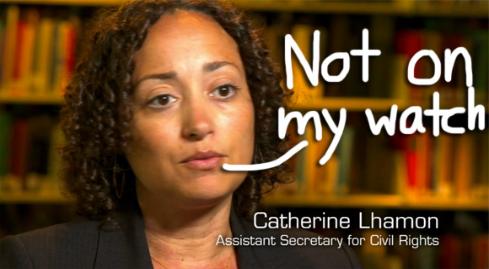
Catherine Lhamon worked on the Los Angeles ACLU case against LAUSD
Blog posts Catherine Lhamon
Catherine Lhamon at presentation in San Diego
Catherine Lhamon, ACLU attorney in LAUSD
last-hired/first-fired case, talks about Betsy
DeVos
Catching up with Catherine Lhamon
By Benjamin Wermund
02/09/2017
The Obama administration’s actions to combat campus sexual assault rocked
higher ed. Now, college leaders and advocates are wondering what to expect
from the Trump administration.
Catherine Lhamon, the chair of the U.S. Commission on Civil Rights who
previously ran the Education Department’s Office for Civil Rights under
President Barack Obama, says she’s dismayed that Education Secretary
Betsy DeVos hasn’t spelled out her position on the federal enforcement role
in campus sexual assault.
Lhamon said she would’ve expected DeVos to walk into her Senate
confirmation hearing prepared to say whether she would maintain the Obama
administration's guidance that spelled out the standard of evidence for
sexual assault administrative hearings at colleges and universities.
“I would have hoped that she had heard from all sides before that date, but I
look forward to her getting up to speed,” Lhamon said. “Also, I noted with
interest her saying that her mother's heart is ‘piqued’ by the issue. I hope it is
piqued in ensuring civil rights for all students under her charge.”
— DeVos, who started work on Wednesday, did not specifically mention the
issue of campus sexual assault in a speech to staff. But she said she's
committed to ensuring that students have "learning environments that foster
innovation and curiosity, and are also free from harm." At her confirmation
hearing, DeVos said it would be premature to say whether she’d keep the
existing guidance in place...
Blog posts Catherine Lhamon
Catherine Lhamon at presentation in San Diego
Catherine Lhamon, ACLU attorney in LAUSD
last-hired/first-fired case, talks about Betsy
DeVos
Catching up with Catherine Lhamon
By Benjamin Wermund
02/09/2017
The Obama administration’s actions to combat campus sexual assault rocked
higher ed. Now, college leaders and advocates are wondering what to expect
from the Trump administration.
Catherine Lhamon, the chair of the U.S. Commission on Civil Rights who
previously ran the Education Department’s Office for Civil Rights under
President Barack Obama, says she’s dismayed that Education Secretary
Betsy DeVos hasn’t spelled out her position on the federal enforcement role
in campus sexual assault.
Lhamon said she would’ve expected DeVos to walk into her Senate
confirmation hearing prepared to say whether she would maintain the Obama
administration's guidance that spelled out the standard of evidence for
sexual assault administrative hearings at colleges and universities.
“I would have hoped that she had heard from all sides before that date, but I
look forward to her getting up to speed,” Lhamon said. “Also, I noted with
interest her saying that her mother's heart is ‘piqued’ by the issue. I hope it is
piqued in ensuring civil rights for all students under her charge.”
— DeVos, who started work on Wednesday, did not specifically mention the
issue of campus sexual assault in a speech to staff. But she said she's
committed to ensuring that students have "learning environments that foster
innovation and curiosity, and are also free from harm." At her confirmation
hearing, DeVos said it would be premature to say whether she’d keep the
existing guidance in place...